Showing posts with label the Dene. Show all posts

Tuesday, June 11, 2019

The Ghost Wood

View of the dene from under the very large ash in the
farmer's field to the south of the property.


How old is the dene and what were its possible prior uses?
In order to discover, I have turned detective. The first bit was to do a brief survey of the trees in the dene – starting at the kissing gate to the footpath and moving upwards towards my section. Below the kissing gate is farm land, mostly run to sheep or occasionally cows. There are some remnants of trees by the stream but I decided it would not offer any real clues. The ash tree is huge there and must have stood the test of time, rough guess it has about 400 inch girth or so and at one point was heavily coppiced but hasn't been for a long time.
Banked earth by the kissing gate's dry stone wall
However, by the kissing gate, I can detect banked earth – in other words, as Rackham predicted there is a bank separating the woods from the arable field. There is also a stone wall which marks out the wooded area enclosing it to the west, including the footpath and seperating it from the arable field (and houses). Again Rackham suggested that this is entirely what one would expect with an older wood which may have been exploited at certain points.
So it would seem to be the ghost of an ancient wood which developed into a boundary or hedge. 
It was not profitable to farm down the dene, but I suspect the trees were exploited in some fashion and many show signs of coppicing which ceased many years ago. Most woods used to be exploited in some fashion, according to Rackham.
The kissing gate leading into the footpath.
On the house side of the dene are the remains of a hedge – the hawthorn, and several holly bushes. To see if my guess was accurate,  I turned to the 1862  OS Map of Haydon Bridge: https://maps.nls.uk/view/102346473  In common with older OS every feature is shown and this is before the house was built in 1908 so it gives some indication of land use.  The dene is clearly marked as a wood and there is clearly a footpath marked through it.  
Looking at the deeds, the house side of the dene belonged to Broom Hill farm at this time and was used as farm land ( I presume livestock). The land to the east and west was owned by the Greenwich Hospital. As an aside, this means it was the Earls of Derwentwater land which was sequestered after the failed Jacobite Rebellion. The Earl of Derwentwater supported Bonnie Prince Charlie and became the last noble to be executed for treason by the crown.  I have no idea when Broom Hill farm became separate from the Earls of Derwentwater land. However it was long enough ago for a footpath to develop and to demarcated by a stone wall on one side.
The name of the house to the south of us which was built in 1902 is Hedgeley and that probably indicates that the dene and its trees were indeed used as a hedge. the suffix -ley normally means a glade within a wood in Anglo Saxon. Going from the OS map, I assume it was named when built and the owners were creating a glade within the hedge. The Dene, the name of my house is self-explanatory and again features the land.
The trees are mixed – Scot’s pine, sycamore, oak, ash, hazel, willow, holly and lime. The Scots pine was probably plant/wind blown sometime in the Victorian era. Sycamore again is mostly likely 18th century or later. The lime is interesting as there appears to be three types – small leafed (pry) in the oldest part of the wood on the footpath. Pry is nearly always an indicator of an ancient wood. There is also a medium sized leaf lime (assuming common lime) – this is within Hedgeley boundaries. And there is the large leaf limes in my section. As there used to be an outcrop of limestone (assume there still is), it could explain the presence of the trees. Alternatively persons unknown planted them awhile ago.
Footpath 
Near to the limes in my part of the dene, in early spring there are white wood anemones. White wood anemones notoriously only grow in ancient woods. They grow through underground runners and advance very slowly. They also do not like being transplanted.  It is only a tiny patch but it is clinging on.  I have no idea if Hedgeley has white wood anemones or not.  However there are hedge plants such as stitchwort and green alknet. 
We also have wild garlic growing in profusion – wild garlic however can be transplanted. It is certainly though a plant which has gone wild in the garden.
Some of our flowers only appeared after we made sure light was getting into the dene – including the bluebells and the stitchwort. This accords with Rackman’s assertion that regular coppicing allowed certain species to colonise. Hedgeley with its closed canopy has slightly different flora. The footpath is much more open and has a mix of species. The sheer mix of flora through out the dene (I walked up the footpath, starting near the farm (no livestock in the field) seems to indicate a longevity.
While I have nettles (sign of human disturbance), Hedgeley's dene and the footpath are remarkably clear of nettles. According to Rackham, true wildwood doesn’t have nettles.
Further up beyond us is farmland where a disused dam resides. It occasionally gets blocked with the odd sheep carcass. The earthworks are huge though and it used to power the gin-gan of Peel Well Farm. The stream probably always has been here, and they simply blocked it as it was the best way to provide power. The stream also serves as run off from various farms (we have had environmental incidents – most recently in April – all I can do is report to the Environment Agency with photos).
It is also clear that my portion of the dene has been a garden for some years, probably over a hundred years (the house was built in 1908). The nettles give it away and there are remains of paths and retaining walls. The more formal part of the garden will have been farmland before the house was built.  I have no real idea of how the Victorian plum tree is (around a hundred years?) but I suspect the back lawn/orchard with wildflowers was at one point a productive orchard. It was also probably a vegetable patch. We have a much smaller veg patch which is now fenced to keep out the hens and ducks.
Where next?
 I need to find out about the outcrop of limestone and why it was considered to be of local geological interest. It was in the late 1990’s that the geologist decided that it couldn’t be seen. He seemed to think this would be better for us. I assumed at the time, it would mean that it could not be exploited. But I suspect I need to do more detective work here but I am starting to get an idea of how the dene can be managed – get rid of/weaken invasive non-natives (ie ground elder) to allow the native wild flora to flourish. The sticks do need to be left in situ as much as possible.
The robin on the footpath.
I also need to put the measuring tape around some of the larger trees as that might help indicate when the wood really developed. My daughter says that I mustn’t put a tape around large ash which is in the field as it isn’t strictly on the footpath. (At 26, she still gets embarrassed by her mother). It is a very large tree. However, I think I can find out a lot through measuring the beech and large leaf lime which are in my portion.  It is merely to discover if the trees were here before the house.  Given what I know about the wood and the surrounding area, it makes no sense for anyone to create an ornamental wood in the dene. There just were no major country houses in the area. The nearest was Langley Castle and that was a ruin during the period of major parkland creation and again it is too far away for that sort of activity to make any sense.
But I have having fun doing the detective work and thinking about the what used to be here and therefore what do the organisms in the soil (the roots if you will pardon the pun of the ecosystem) want to support?
On my walk up the dene, I noticed a robin (hopping in front of me as if to make sure I had filled in all the forms correctly)  as well as specked wood butterflies. It is the stopping and looking which has me noticing these things and that has to be a good thing.


Tuesday, May 21, 2019

Introducing the site -- Wilding at the Dene


Basically if I am going to talk about the dene, you will need to know about the site. We are on a bend in the road and the wooded area at the top of the picture is us. The label is for the care home, but on the wrong house as that is a newer house which was built in their orchard. 
 The house was built in 1908 and has had 5 or so owners. Prior to that, it was part of a farm. Someone disappeared in the Australian outback and had to be declared dead before it was broken up in the late 19th century but that is about as exciting as the history gets.  I have no idea how the mysterious got that strip of land but would like to think it had something to do with the Earls of Derwentwater as it is as far as I can remember the Greenwich Catholic trust. 
Standing near the willows,
 on the footpath side of the dene


 I am pretty sure the dene part was ancient woodland as there are wild garlic, and white anemones in the spring.  
Various strips of land were added, particularly in the early years. I suspect they had to site the house differently and had to purchase more land. That part has the remains of being formal and to the front. The dene is to the side. And then in the 1950s, the bit over the bridge was added. This period was supposed to be a bit of heyday for the garden.
   In the 1960s, the property was sold to the Hedleys who had it until Mrs Hedley went into a home in the early 1990s. A couple bought it to do it up and then promptly decided to get a divorce. It rapidly went back on the market and we eventually purchased it for a decent price in 1996. I suspect most people thought something was really wrong with the house as lots of people had viewed it when Mrs Hedley sold it.  
Mrs Hedley was a keen gardener (president of the British desert cactus society in the 1960’s –  hence the greenhouse) but frail in her later years. For most of her tenure, the dene part was not  managed. In the end the garden became too much, even though she had a gardener whom I met when I first moved here. He said that she liked to think about the birds. The people before us were keen on trimming hedges and that is about all. When just before we moved, the greenhouse was destroyed by a car, the wife directed the builders to throw all glass down into the dene as it was bound to wash away and no one went there anyway. I spent a great deal of time hauling broken glass out that first winter so that the children would not get hurt.  
Looking at the middle pool
What all of this means for the garden is that when we took over, there were various plants from various eras. Gardening goes in fashions and some plants are more popular during certain eras. Know the plant and sometimes you can hazard a guess when they were planted. For example we have a profusion of snowdrops which I believe are Galanthus Samuel Arthnott – they were known from the 1900s but first exhibited in 1951 so I suspect the first plantings were done in the 1950s. There is also a gold dust plant and a few other popular 1950’s specimens in what we call the winter garden (we can see it in the winter) just over the bridge and so I suspect that part was planted up in the 1950s and then left when the Hedleys took over.
 When woodland is not managed, it closes down and reverts to deep shade which many garden birds actively avoid. So while she might have liked to think about the birds, there were very few birds here when we arrived. There were also very few perches for birds in the more formal part of the garden.  One of the first things we did was to get the tree surgeon in and get the trees trimmed and the scrub sorted. We also trimmed back the ivy and uncovered long neglected bushes.
We had so many bonfires that winter (getting rid of old fences in the main)  that when the barn further down the bank went up in smoke, our next neighbour phoned to see if we were busy burning again. I replied – In a gale? I ran to the window and saw flames further down the road.  My children were delighted to watch the firemen arrive and hook up the hoses. Alas the barn burnt to the ground and to this day remains a concrete shell.
Looking up towards the bridge at the hawthorn'
sweet chestnut behind
 on the house side of the dene
The stream is connected to an old farm pond which sometimes the farmer neglects. It used to run the gin-gan. One year, we had the firemen back out pumping the pond as  a sheep had died and blocked it. Had the Victorian earthworks gone, the entire village would have been threatened. The stream also serves as a storm overflow. Sometimes the farmers do discharges and this results in incidents.
But no pesticides have been used for years as far as I can figure.
 We uncovered paths and found bits of the garden that we had not quite realised existed that first winter. Sometimes it was obvious that certain things were once a specific garden but trees had grown far too big. 
The conifer by the greenhouse was a case in point but a huge focal point from the village. That is until 2013 when a storm hit and blew it into the greenhouse. The sweet chestnut now has room to grow.
There are loads of levels to this garden – it is in a small wooded valley and therefore pathways and parapets. Many of the walls have ivy growing up. And as I suffer from ecological tidiness disorder, I have a tendency to cut the ivy every so often so that it stays on the walls, doesn’t swamp plants and we can see the garden.  We do it in the winter so that the birds are not nesting, and it does return. However, I suspect this has to change and beating myself up over the past is not going to help matters.  There is a balance to be struck and I suspect I have gone too far on the side of human tidiness rather than benign neglect. It is going to have to be something I work on – not tidying things up too much. And I can’t beat myself up too much. It is just things are going to have to change but I had to physically stop myself pulling ivy out of the wall by the cars this morning.

Monday, May 20, 2019

The Penny Drops -- Wilding the Dene


History will have to record that the greatest tragedy of this period of social transition was not the vitriolic words and the violent actions of the bad people but the appalling silence and indifference of the good. Our generation will have to repent not only for the words and actions of the children of darkness but also for the fears and apathy of the children of light.
--Martin Luther King Jr
I will number myself among the complacent about the environment. I like to think of myself as one of the Good – I keep bees, the last time the garden saw pesticide was probably 1996 just before we moved in, we have had a programme of making sure a good majority of the plants were  good for the bees since 2000 (starvation of colonies is real), and my hens and ducks have roamed free during the day since 1998. My various cats have been indoor cats since about the time Penny encountered a hen in 1998. We know we have foxes and so when Penny and Tuppence went, my husband suggested that we keep the next lot in. We recycle and try to avoid single use plastic and so on.  I can give loads of reasons why I thought I was doing enough including raising three children who were environmentally well (two of which work in the sector). I thought I could rest on my laurels so to speak. Other people maybe needed to change but me – I was good. After all I was doing my best and the less environmentally aware were the ones
The penny dropped last week.  
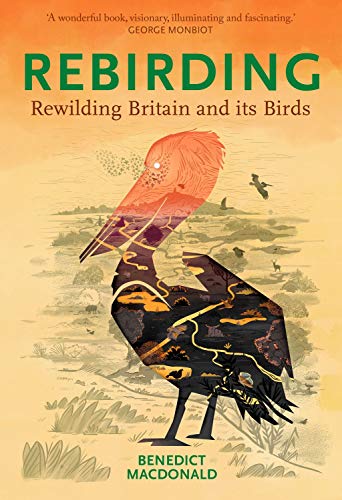
I read Rebirding by Benedict MacDonald and realised that I had become infected with the new normal. I simply had not noticed the decrease in the bird and insect population. He gives an example of a fig tree  where hornbills just to go to feed and the clearing teemed with life and sound but one day the tree was cut down and the hornbills no longer visited the area. They may have found food elsewhere (if they were lucky) or they may have starved. However, people going to that clearing after the fig were greeted by silence. They had no idea that hornbills ever fed there. Their normal was not hornbills in a fig tree but a silent clearing where one or two other birds flickered about.
And suddenly I understood that I had been part of the complacent and the appallingly silent. I have also suffered to greater or lesser extent from Ecological Tidiness Disorder in my quest to a garden which is pleasing to the eye as well as supporting my bees.
MacDonald gives some very sobering figures of the decline in birdlife in the British Isles and the crash in the insect population. It is easy to forget in a world where one puts out bird food for the birds that different species have different feeding requirements. And for some, if they can’t find the insects, they starve. Insects are dependant on certain types of plants. They have evolved. Not all plants will host insects equally. Insects have spent  thousands of years evolving to feed off specific plants. When those plants are not there, they can sometimes adapt but sometimes they starve. And when they die, the birds who feed on them, do not thrive, go elsewhere where there is more competition etc. Because of research into migration and the mind maps birds carry, we are learning that it is not as easy as once thought to increase populations. For example, there is no point in building the perfect habitat for a pine marten in Sussex and hoping that one will appear – their range doesn’t include Sussex. And in dealing with animals, you do have to think range. Britain is on the Western edge of the range for many birds.
While it is depressing, MacDonald gives hope and that hope comes from the concept of rewilding. In short, making sure the environment is not managed for just one species, but rather looked at as an ecosystem as a whole. It is about working with nature, instead of against it. However, I don’t think he is much of a gardener or completely understands some of the trouble. It is not just the people who have paved over everything, have decking, and use pesticides at every opportunity who need to change, but also the people who garden for wildlife who have to change as well. We, the complacent good, must alter our behaviour to ensure things actually change.
Ecosystem gardening is actually far harder than it sounds and is why it isn’t usually practiced.  In one sense it is simply an extension of Beth Chatto’s philosophy of the plant to suit location but in another, you do have to be aware of what insects the plant will host etc. And it is gardening more for the longer term.
My youngest son who is currently a Master research student at St Andrews and is in Cyprus studying fledgling behaviour of the Cyprian wheatear and who has not read the book is so pleased that the scales have dropped from my eyes about the seriousness of the problem. Although, he did think it amusing I got in a totally unintentional twitter spat with Monty Don when I asked if Gardener’s World could try to make native plants aspirational rather than highlighting things like tree ferns. My intentions were good, but my wording was misconstrued. My son found out about it when a fellow researcher in Cyprus asked him if his mother’s name was Michelle. I got a phone call.
 My son is an ornithologist rather than a plantsman and didn’t totally understand about  some of the ways in which the wildlife gardener  might have inadvertently assisted in the decline from sterile hybrids of native plants to the use of exotics which have evolved to support other ecosystems  to create sterile green deserts which look natural but are almost incapable of supporting any native fauna. He now does (sort of). This problem is also one environmental consultants in planning have been highlighting for years but one which has been overlooked by gardeners and gardener designers.
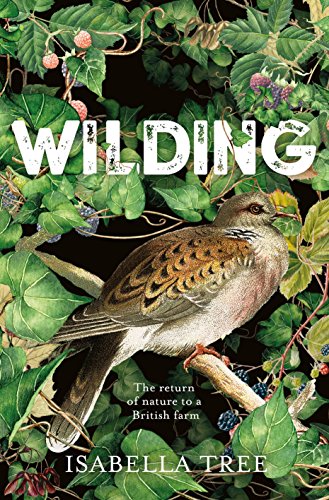
He suggested I read Wilding by Isabella Tree if I wanted to know more. It is an excellent book but had I read it first, it would not have had as big an impact as Rebirding as I would have thought – ah but I am one of the Good and her experience has nothing to do with me, really.  The calls to action are many and varied.
Wilding also made me feel better – much of what I am doing has been good. Actually better than good.  I can do with few more tweaks in my approach and losing of my ETD especially in pulling nettles and brambles (A sore point with my son. In his first year of uni, my son was once sent out to recover from a bad hangover and made to pull brambles while I dealt the state of his bed. He spent much of the time staring up at the sky as I had suspected he would) but on the whole the bones are there. I just need to look at the garden with different lenses.
 The other good part is because the next door neighbours operate a more than begin neglect policy on their part of the dene and the public footpath goes through a strip of land owned by a mysterious trust which has not been touched for decades really, the natural haven where I garden actually has far more areas and is bigger than I first thought.
 I have no intention of getting into any more spats or trying to provoke and see little point in trying to get the bad to change their ways (I leave that to others), instead I want to persuade and that is why I am going to devote part of this blog to writing about The Dene and my efforts at ecosystem gardening to create more of a haven for nature. I am going to detail the beginnings and what we have done, impart  how to garden with free roaming ducks and hens and still have a decent border and vegetable patch etc as well explaining about my efforts to be a better ecosystem gardener. One of my latest projects (forced by Hugh Buff-Orpington, our cockerel) has been to turn the old back lawn into an orchard under planted with wildflowers. In part because it can be so overgrown, I have hesitated to share but I think the time is right.
I hope this helps or inspires someone. There will still be bits about my own historical romance writing but I think this is a worthwhile project. So please bear with me as I give some insight into my attempts. I am going to make mistakes. I am a very flawed human being but my intentions are good. At the very least it will provide me with procrastination distraction from my latest wip which is at POS stage. 
If you are interested in getting involved in Rewilding Britain, do visit their website to find out more.